Breaking writing rules
The difference between a rule broken well and a manuscript that just needed a firmer edit comes down to one thing: intent. A writer who breaks a convention without knowing why it exists usually produces something that reads as a mistake. A writer who understands the convention, knows exactly what it protects the reader from, and decides the story is better served by removing that protection — that's a choice a reader can feel, even if they can't name it. Below are ten conventions writers break constantly, with examples of where it worked, drawn from classic literature and from fantasy both historical and contemporary.
Changing POV mid-paragraph or mid-chapter
The standard advice: pick a point of view and hold it, at least for the length of a scene. Switching from one character's head to another's — worse, from first person to third — disorients the reader, who suddenly can't tell whose story they're following.
It works when the switch is anchored to something the reader can see. Barbara Kingsolver's The Bean Trees alternates first-person chapters from its protagonist with third-person chapters following a second storyline, all the way through the novel. The technique holds together because every switch happens at a chapter break — never mid-scene — so the reader always knows, within a sentence, which register they're in. That's the same mechanic behind the case worth revisiting from Finding your writing style: a novel that alternates a first-person internal voice with third-person narration by chapter can work precisely because the chapter break does the signaling the reader needs.
Virginia Woolf takes the riskier version of this rule and elevates it into her entire method. In Mrs Dalloway, she described her process as a "tunnelling" technique — moving the narrative voice between characters' minds within a single continuous scene, with no chapter break at all, using free indirect discourse to slide from one person's thoughts into another's mid-paragraph. It works because the drift itself is legible as a drift; the prose signals the handoff through rhythm and focus, not through a hard cut, so the reader tracks the movement instead of being ambushed by it.
The rule of thumb underneath both examples: readers will follow you almost anywhere as long as they always know where they are. Give them a chapter break, or make the transition smooth enough that it reads as intentional, and the switch stops being a mistake.
Show, don't tell
The rule exists because inexperienced writers default to telling constantly — stating that a character is grieving instead of building a scene that makes the reader feel it. As general advice for a first draft, it's sound.
But summary and exposition aren't the enemy; they're what holds scenes together and moves time forward. Jane Austen opens Pride and Prejudice with a flat authorial assertion about wealthy bachelors and marriage — pure telling, delivered with total confidence, and it's one of the most famous opening lines in English fiction precisely because the telling is doing ironic work the scene couldn't do as efficiently. Sebastian Barry's Days Without End goes further: long stretches of the novel are narrated almost entirely in summary rather than scene, and it works because the narrator's voice is compelling enough that being told the story by him is the pleasure, not a shortcut around one.
Fantasy leans on telling constantly, often without readers noticing. Ursula K. Le Guin's Earthsea books regularly summarize years of a character's life in a paragraph between scenes. J.R.R. Tolkien tells far more than he shows across The Lord of the Rings — entire chapters of history, lineage, and backstory delivered as narration or in-world documents rather than dramatized. Neither writer is failing at craft. Both are using telling to control pace across a story that spans too much time and too much history to dramatize all of it.
Writing an action-packed first chapter
The common advice is to ease a reader into a story — establish a character and their ordinary world before the stakes arrive, so the reader has someone to root for once the trouble starts. Opening in the middle of a fight, a lot of craft books will tell you, wastes tension on a reader who doesn't know the characters well enough to care yet.
This is also the oldest storytelling convention there is being contradicted by an even older one. Epic poetry begins in medias res as a rule, not an exception — the Iliad opens in the middle of a war already nine years old. Modern fantasy uses the same move constantly. George R.R. Martin's A Game of Thrones opens with a prologue that ends in violence, then moves straight into Chapter 1 with young Bran Stark riding out to watch an execution before the book has spent a single page on ordinary life at Winterfell. Mark Lawrence's Prince of Thorns goes further still, opening on the smoking aftermath of a village its narrator's own men have just destroyed — a chapter divisive enough that it's cost the book readers, and also the exact chapter that establishes protagonist Jorg's voice and moral register so completely that everything after makes sense because of it.
What both examples share isn't just action — it's a controlling voice or perspective steady enough that the reader has something to hold onto even before they understand the stakes. Action without a clear point of view is chaos. Action anchored to a voice the reader can track is a hook.
Prose style
Most style guides push toward invisible, economical prose — the idea that ornate language draws attention to the writing instead of the story. It's good advice for writers whose ornamentation isn't earning its place yet.
Daniel Keyes' Flowers for Algernon breaks the consistent style rule as its entire structural device: the prose starts simple, climbs into dense, intellectual complexity as its narrator's intelligence rises, then collapses back into simplicity as it falls. The shifting prose style isn't an inconsistency to be edited out — it's the plot, rendered at the sentence level.
Fantasy runs the full range on this axis by design. Mervyn Peake's Gormenghast novels are dense, ornate, and unhurried in a way that would get flagged in most workshops, and the density is inseparable from the gothic, claustrophobic atmosphere the books are built on. Set that against Ursula K. Le Guin's spare, controlled prose in the Earthsea books, or Joe Abercrombie's flat, unsentimental grimdark sentences — both are also considered exceptional prose stylists, working in the opposite direction. There's no universal correct register. There's only the register a particular story needs, applied with control.
Writing tip
Take a page in your manuscript and cut it down like Hemingway would, removing filler words, long, flowery prose and see what is left.
Next, take that same page and expand on your prose, pushing it as much as you can with descriptions, go crazy with it.
In bewteen both forms of prose is often where you’ll find your own prose writing style. The exercise is to for you to push the boundaries of prose to write something that ends up being magical, and in your voice.
Grammar & punctuation
Standard grammar and conventional punctuation exist to keep prose legible without friction. Breaking them on purpose is one of the higher-risk moves on this list, because readers notice fast and not all of them forgive it.
Cormac McCarthy's Blood Meridian drops quotation marks around dialogue almost entirely and strips out as much punctuation as the sentence can survive without. It divides readers — some find it disorienting, others find that the sparseness matches the stripped-down, brutal world the novel describes. James Joyce does something more extreme in the closing chapter of Ulysses, Molly Bloom's interior monologue, which runs for pages with almost no punctuation at all, mimicking the unbroken flow of a mind that doesn't pause for full stops. Charles Dickens breaks grammar in the opposite direction at the start of Bleak House: the opening paragraphs are built from sentence fragments rather than complete sentences, piling up short, punctuation-heavy phrases to build the fog itself into the reading experience before a single character appears.
Fantasy has its own grammar-breaking landmark: N.K. Jemisin's The Fifth Season narrates its central storyline entirely in second person present tense — "you" instead of "he," "she," or "I" — a grammatical choice almost never sustained across a genre novel. It works because the address to "you" mirrors the character's own dissociation from herself, so the unconventional grammar is doing psychological work, not just novelty.
Writing tip
Take some of your paragraphs and re-write them based on changed conventions. Remove punctuation, read The Fifth Season and re-write some of your sentences in that same style. This is not a lesson on copying another writer’s style, it’s to help you find your own, and push the bounds of grammar and punctuation rules.
Writerly styles & letting the author show through
Most modern fiction hides its author. The convention is that the narrative voice should feel like it belongs to the story, not to a visible person sitting behind the page reminding you that you're reading a book.
That convention is younger than the novel itself. Don Quixote constantly breaks it, with a narrator who comments on the story, references its own writing, and talks to the reader directly. Henry Fielding does the same across Tom Jones, opening sections with authorial digressions before returning to the plot.
Fantasy has its own version of the visible author, usually deployed for comic or scholarly effect. Terry Pratchett's Discworld novels are threaded with footnotes in the author's own voice, cracking jokes or adding context the story doesn't strictly need — a device that shouldn't work in fiction and works constantly because the footnotes are as funny as the text they're attached to.
Susanna Clarke takes the same device in a completely different direction in Jonathan Strange & Mr Norrell, building out an entire fictional scholarly apparatus of footnotes that cite invented books and invented historians, making the fantasy feel like verified history rather than invention.
Both examples make the same bet: that a visible authorial presence, used consistently, becomes a feature of the book's world rather than an interruption of it.
Writing tip
Add some footnotes to your pages and text in different POVs, cited references, narrator comments, or a character who is reading it and may disagree with the context, or add some context as the case may be.
Add an epigraph for each chapter that references an ancient text, diary entry or a narration note. It could be a quote from one of the characters as well. The choice is yours.
Italics, capitals, & different fonts for different voices
The typographic convention is to keep formatting plain and let word choice and rhythm carry a character's distinctiveness, rather than leaning on visual tricks.
Terry Pratchett breaks this as one of Discworld's most recognizable devices: Death, present in nearly every novel starting with The Colour of Magic, speaks entirely in small capitals with no quotation marks, so his dialogue is visually distinct from every other character's on the page before a reader even processes the words.
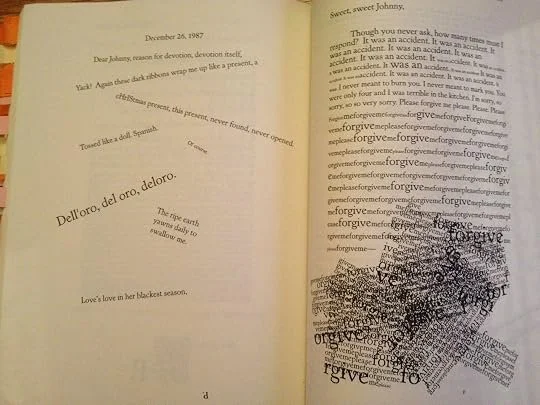
House of Leaves by Mark Z. Danielewski. Source: Goodreads
Mark Z. Danielewski takes the same idea to its extreme in House of Leaves, using multiple fonts for different narrators and warping the page layout itself — text spiraling, boxed, or scattered — to mirror what's happening in the story at that moment.
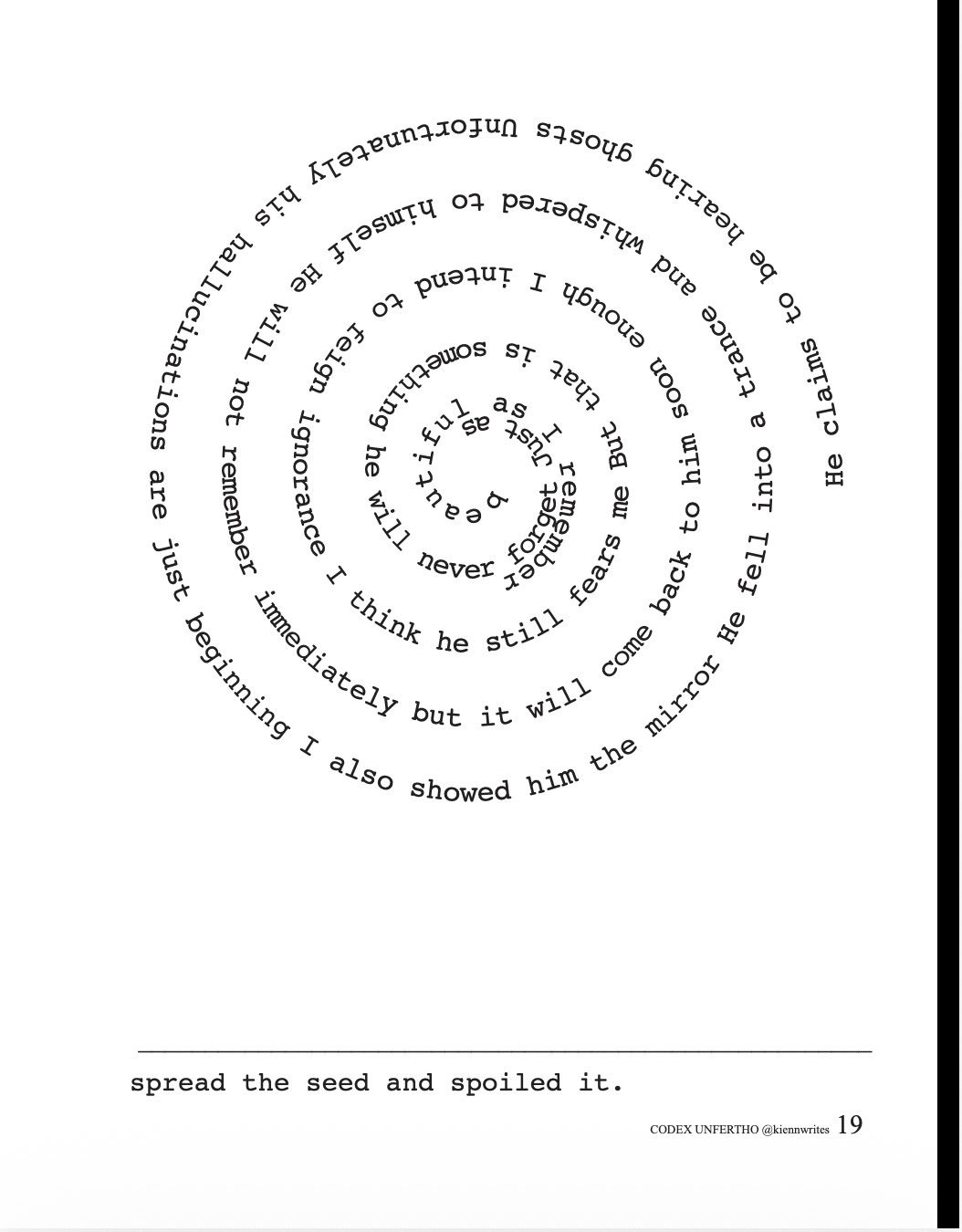
Codex Unfertho by Kienn Nguyen, page 19.
Indie ergodic horror author novel Codex Unfertho by Kienn Nguyen is another interesting example of pushing typographic conventions. Nguyen has created a cult following and continues to push boundaries between stoic literary rules and contemporary storytelling pathways.
There is a writing prompt making the rounds where authors use the prompt to create their own books.
“POV: You are writing a book where the main character slowly goes insane, and the text of the actual book starts reflecting their madness."
Genre fiction can lean on a gentler version of this by using italics for telepathic speech, for the voice of a spirit or inner companion, for a POV character's unfiltered thought breaking through close third-person narration. It's a small typographic break from the norm, but it does real work — it tells a reader instantly which register they're in without needing a dialogue tag to explain it.
Writing internal dialogue
Modern craft advice tends to discourage direct thought tags — "he thought," "she wondered" — pushing writers toward close third-person narration where a character's thoughts are folded into the prose itself, no tag required. The instinct behind the advice is sound: thought tags at every turn get repetitive fast.
Jane Austen is the writer usually credited with pioneering the alternative at scale. In Emma, she developed free indirect discourse to the point where a reader often can't locate the exact boundary between the narrator's voice and Emma's own thoughts — no "she thought," no quotation marks, just the character's judgment and phrasing bleeding directly into the narration. It's a technique so effective it became the default toolkit for close third person in the two centuries since.
Robin Hobb solves the same problem by removing the boundary entirely. Assassin's Apprentice is narrated in first person as Fitz's own memoir, so there's no need for thought tags at all — the entire book is already inside his head, framed as him recounting his own life. The lesson isn't that "she thought" is always wrong. It's a tool, useful for clarity especially in scenes with more than one viewpoint character nearby. It becomes a crutch only when a writer reaches for it out of habit instead of using the narration itself to carry the character's interiority.
Head-hopping
The modern rule is strict: one character's interiority per scene. Dipping into a second character's thoughts without a scene break is considered one of the clearest marks of an inexperienced manuscript, because it's disorienting when done by accident.
It happens more often than craft books suggest, even in books widely regarded as well written. Frank Herbert's Dune and Philip K. Dick's Do Androids Dream of Electric Sheep? both head-hop within their opening pages — a brief line dropping into a second character's thoughts mid-scene, then returning. It reads as a deliberate widening of perspective rather than a mistake because it's brief, controlled, and never spreads across more than two minds in a scene.
Virginia Woolf turns the same technique into her whole method rather than an occasional device, using free indirect discourse in Mrs Dalloway to move fluidly between many characters' minds within a scene, sometimes within a sentence. The difference between Woolf's version and an accidental slip in a first draft is control: Woolf's transitions are legible as transitions, signaled by rhythm and focus, never a jarring jump the reader has to double back to understand.
Writing long, flowery prose
The advice to trim adjectives and cut description to the bone is sound for most modern commercial fiction, where pace usually matters more than ornament. But "sometimes it just works" is also true, and some of literature's most famous passages are proof.
Charles Dickens opens Bleak House with an extended, purely atmospheric description of London fog — paragraphs of it, before any character has spoken a word — and it's regularly cited as one of the greatest openings in English literature rather than a pacing failure, because the fog isn't decoration. It becomes the governing metaphor for the entire novel's central subject, the endless Chancery lawsuit, before the plot has even started. Robin Hobb writes paragraphs that run longer than a page throughout the Farseer books, unhurried and dense with sensory detail, and readers who love the series cite that slowness as the reason the world feels lived-in rather than sketched. J.R.R. Tolkien's descriptive passages — Lothlórien is the standard example — run long by any modern editorial standard and remain some of the most quoted prose in the genre.
The thread connecting all three: the length is doing something. It's building a world's texture, establishing a governing mood, or mimicking the unhurried pace of a story that isn't in a rush. Long prose fails when a writer mistakes length for depth. It works when every extra clause is still earning its place.
The actual rule
None of these writers broke convention because they didn't know better. Every example above comes from a writer who understood the rule well enough to see exactly what it would cost the story to keep it, and made the trade on purpose. That's the only real test before you break one of these conventions yourself: not whether the rule is inconvenient, but whether your specific book is better for the exception than it would be for the observance. If you can answer that clearly, break it. If the honest answer is "I just didn't know," that's worth learning the rule properly first — not because rules are sacred, but because you can't make a deliberate exception to something you haven't fully understood yet.
FAQs
What is an epigraph?
An epigraph is a short quotation, poem, or sentence placed at the beginning of a chapter or book to suggest its theme, set the tone or add important information or context to the chapter.